Short answer: Turn the range hood on whenever you cook, use the back burners when practical, and leave an outdoor-vented hood running for 10–20 minutes afterward. Keep the grease filter clean using the exact owner's manual, and replace rather than wash a charcoal filter unless the manufacturer explicitly says it is washable. The best upgrade is often consistent use plus a clean capture path: a higher fan setting cannot fully compensate for a grease-loaded filter or a front burner outside the hood's best capture zone.
The useful routine
- Turn the hood on before heat, smoke, or steam spreads.
- Use back burners when practical so the hood captures more emissions.
- Leave an outdoor-vented hood on 10–20 minutes after cooking.
- Clean metal grease filters as the manual permits.
- Replace recirculating charcoal filters on the model-specific schedule.
Ducted and recirculating hoods do different jobs
A ducted hood moves captured air outdoors. EPA prefers outdoor venting when possible because cooking can generate particles, moisture, and combustion byproducts. A recirculating hood sends air back into the room after filtration; its grease filter catches residue while a charcoal filter may reduce some odor, but it does not exhaust moisture or pollutants outdoors.
Do not assume a microwave hood is ducted just because it has a fan. Check the installation manual, cabinet above the unit, and exterior termination. Never alter ducting, gas-appliance ventilation, or makeup-air provisions as a casual cleaning project.
How to use the hood for better capture
- Start early. Switch the hood on before cooking begins.
- Favor the back burners. EPA says this can improve airflow to the hood and reduce particles escaping into the room.
- Match speed to the task. Use more airflow for frying, searing, or visible smoke, while avoiding unnecessary noise that makes you stop using the hood.
- Keep it running afterward. EPA recommends 10–20 minutes for an outdoor-vented hood.
- Reduce emissions at the pan. Avoid deliberately charring food indoors and lower heat when the recipe allows.
Clean a removable metal grease filter
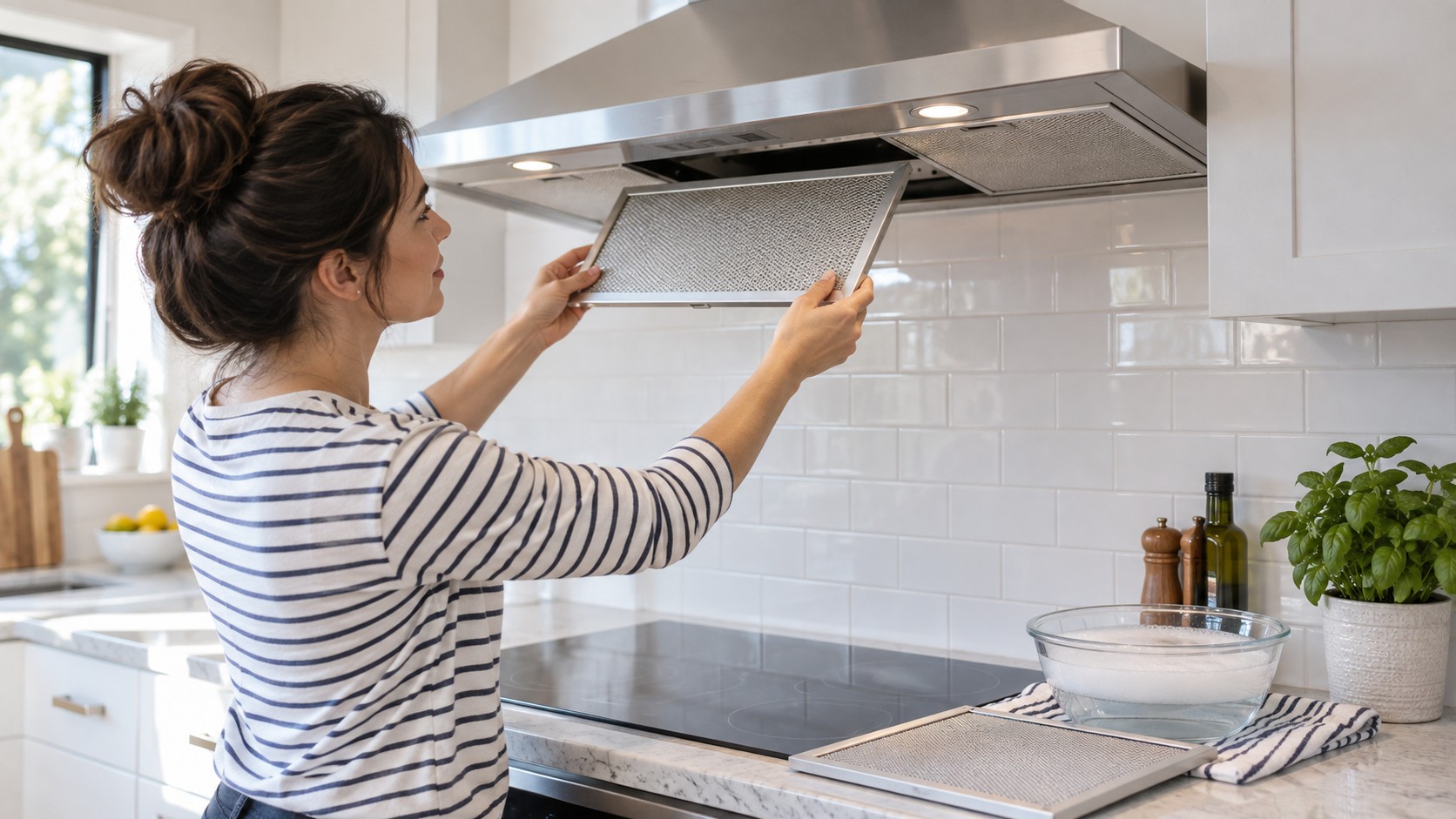
- Turn every control off and wait until the hood and cooktop are cool.
- Support the filter with one hand and release it exactly as the manual shows.
- Check whether the filter is dishwasher-safe. Do not assume all finishes or filter assemblies are.
- If hand washing is permitted, soak it in warm water with mild detergent and use a soft brush on stubborn grease.
- Rinse completely and let the filter dry before reinstalling it.
- Confirm it locks flat and securely before using the fan.
Whirlpool allows warm water and detergent in a sink or dishwasher for specified removable filters. Broan-NuTone recommends a warm mild-detergent soak and says to confirm dishwasher compatibility in the manual. These are manufacturer examples, not permission for every hood.
Charcoal filters are usually replacement parts
Recirculating hoods often use a charcoal or carbon filter in addition to the grease filter. Whirlpool says its non-vented charcoal filter is not washable and may last up to six months with normal use, but intervals vary with the model and cooking load. Frying and wok cooking can shorten service life. Use the exact part number and schedule in the owner's manual.
How often should the grease filter be cleaned?
There is no single safe calendar for every household. Inspect more often when you fry frequently, cook daily, see grease on the hood underside, notice declining airflow, or find the filter sticky. A monthly check is a practical reminder, but the manual and actual buildup determine whether cleaning is due.
If you do not have outdoor exhaust
When outdoor air quality and weather permit, EPA suggests opening windows or doors and using a kitchen or window exhaust fan that vents outdoors. A correctly sized portable air cleaner that does not produce ozone can supplement these steps, but it does not remove cooking moisture or replace source capture.
Stop and get qualified help when
- You smell gas, a carbon monoxide alarm sounds, or combustion products appear to spill into the room.
- The fan sparks, trips a breaker, makes unusual mechanical noise, or has damaged wiring.
- Grease is inside inaccessible ductwork or around the motor.
- A high-airflow hood may be backdrafting a natural-draft water heater, furnace, or other combustion appliance.
- Filter removal requires opening electrical or service panels.
The practical bottom line
Use the hood every time, capture from the back burners when practical, and keep the approved filter path clean. Replace non-washable charcoal media rather than trying to degrease it. Continue with indoor air quality basics, review safe garbage-disposal cleaning, or browse the Kitchen hub.
Sources
These official references were used for the factual guidance and limits above.