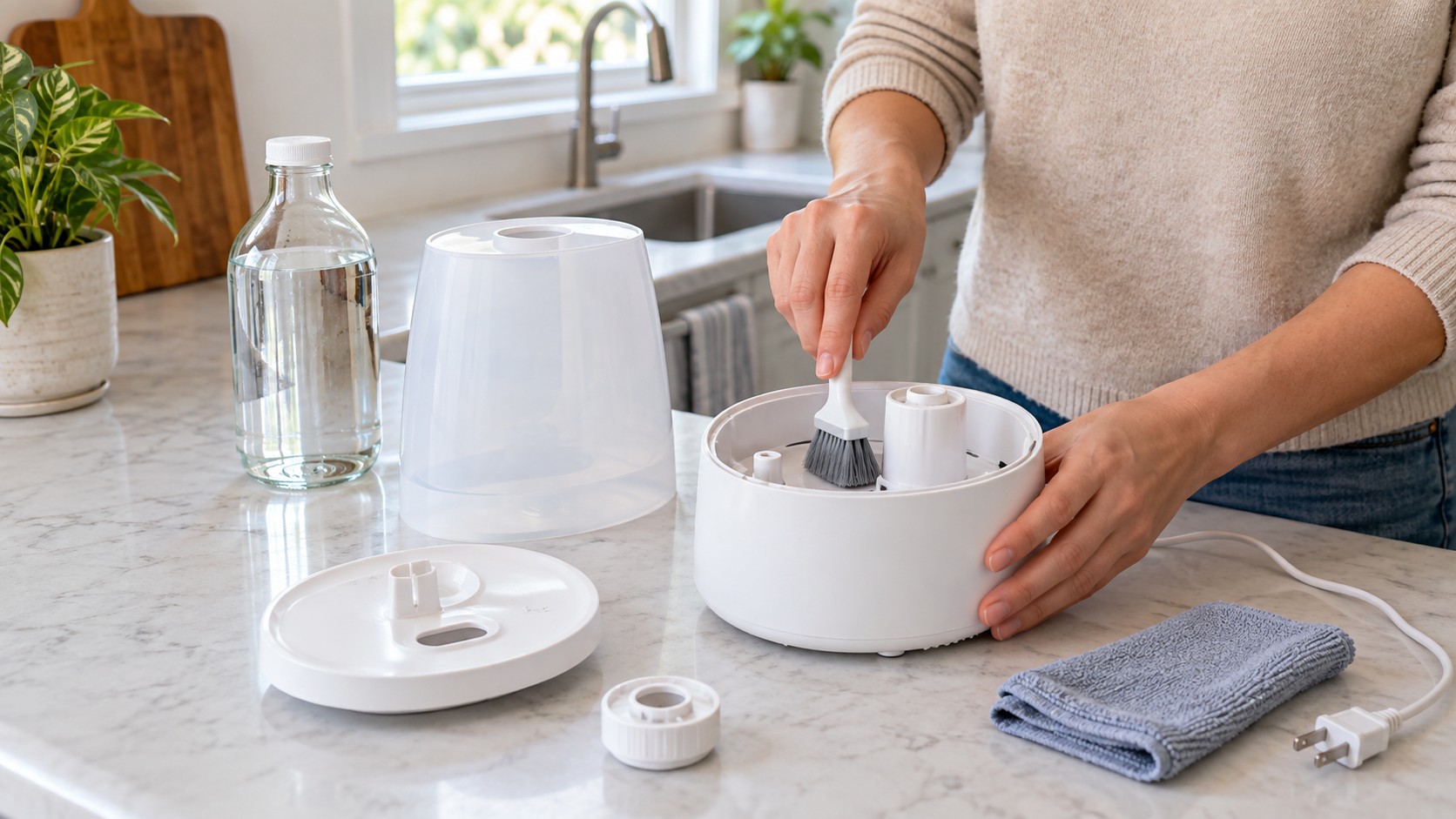
Short answer: Unplug the humidifier, empty leftover water, wipe the tank and wet surfaces dry, and refill with fresh water each day. Every third day, clean away film and scale using the product manual's method, rinse thoroughly, and dry before refilling. For ultrasonic and impeller models, distilled water can reduce mineral buildup and the white dust that may settle around the room. The best maintenance payoff comes from fresh water and complete drying every day; stronger cleaning products cannot compensate for water left standing between uses.
The simple schedule
- Daily: unplug, empty, wipe dry, and refill with fresh water.
- Every third day: remove film, scale, and deposits from water-contact surfaces.
- As specified: clean or replace filters, wicks, cartridges, and belts.
- Before storage: clean, dry completely, and discard used replaceable media.
Why standing water is the main problem
EPA says microorganisms can grow in tanks that hold standing water, and ultrasonic or impeller humidifiers can disperse microorganisms and minerals from their tanks into indoor air. CPSC similarly warns that bacteria and fungi may grow in dirty tanks and be released in mist. Film, scum, or a persistent odor means the unit needs attention before it runs again.
Daily care takes only a few minutes
- Unplug first. Disconnect the unit before lifting the tank, wiping the base, or touching water-contact parts.
- Discard leftover water. Do not top off yesterday's water.
- Wipe accessible wet surfaces dry. Use a clean soft cloth and do not immerse the electrical base.
- Refill with fresh water. Use the water type specified by the manufacturer.
- Keep the surrounding area dry. Lower output or run the unit less if the table, wall, carpet, drapes, or window become damp.
Clean every third day
EPA recommends cleaning portable humidifiers every third day. Empty the tank, remove scale or film with a soft brush or other non-damaging tool, and use only cleaners or disinfectants allowed by the manufacturer. EPA notes that, when no product-specific recommendation exists, a 3% hydrogen peroxide solution may be used on water-contact surfaces. Never mix cleaning chemicals.
Rinse the tank with several changes of tap water after any cleaner or disinfectant. This step matters because residue left behind can be dispersed into the air when the machine runs. Dry the parts, reassemble only as the manual directs, and replace filters or wicks on the manufacturer's schedule or sooner when dirty.
White dust: change the water, not just the cleaning frequency
White dust is typically mineral material dispersed by ultrasonic or impeller humidifiers. EPA advises bottled water specifically labeled distilled when you want to reduce mineral exposure and scale. Bottled “spring,” “artesian,” or “mineral” water is not the same thing, while a label that says only “purified” does not identify which mineral-removal process was used.
A manufacturer-approved demineralization cartridge may help, but EPA says performance and service life vary. If white dust returns, treat that as evidence that minerals are still passing through rather than assuming the cartridge is working.
Do not over-humidify the room
EPA recommends not exceeding 50% relative humidity indoors. Use a hygrometer rather than guessing from how the air feels. Condensation on windows, walls, or pictures—or dampness near the unit—is a signal to lower the setting, move the humidifier, or use it intermittently.
Stop using the humidifier when
- Film, odor, or deposits remain after manual-approved cleaning.
- The tank, seal, cord, plug, or electrical base is cracked, leaking, damaged, or unusually hot.
- Cleaning would require opening the motor or electrical enclosure.
- A steam vaporizer could be reached by a child; CPSC and EPA note the burn risk from steam and boiling water.
- You develop respiratory symptoms that appear connected to humidifier use; EPA advises stopping use and contacting a physician.
Storage without a dirty restart
At the end of the season, clean the humidifier, rinse it, and allow every part to dry completely before storage. Dispose of used filters, cartridges, or cassettes as directed. Clean the unit again after storage before the first use.
The practical bottom line
Fresh water daily, dry surfaces, a full clean every third day, and humidity at or below 50% are the useful baseline. Distilled water is especially helpful for ultrasonic and impeller models when scale or white dust appears. Pair this routine with the indoor air quality guide, review moisture and mold prevention, or browse the Cleaning hub.
Sources
These official references were used for the factual guidance and limits above.