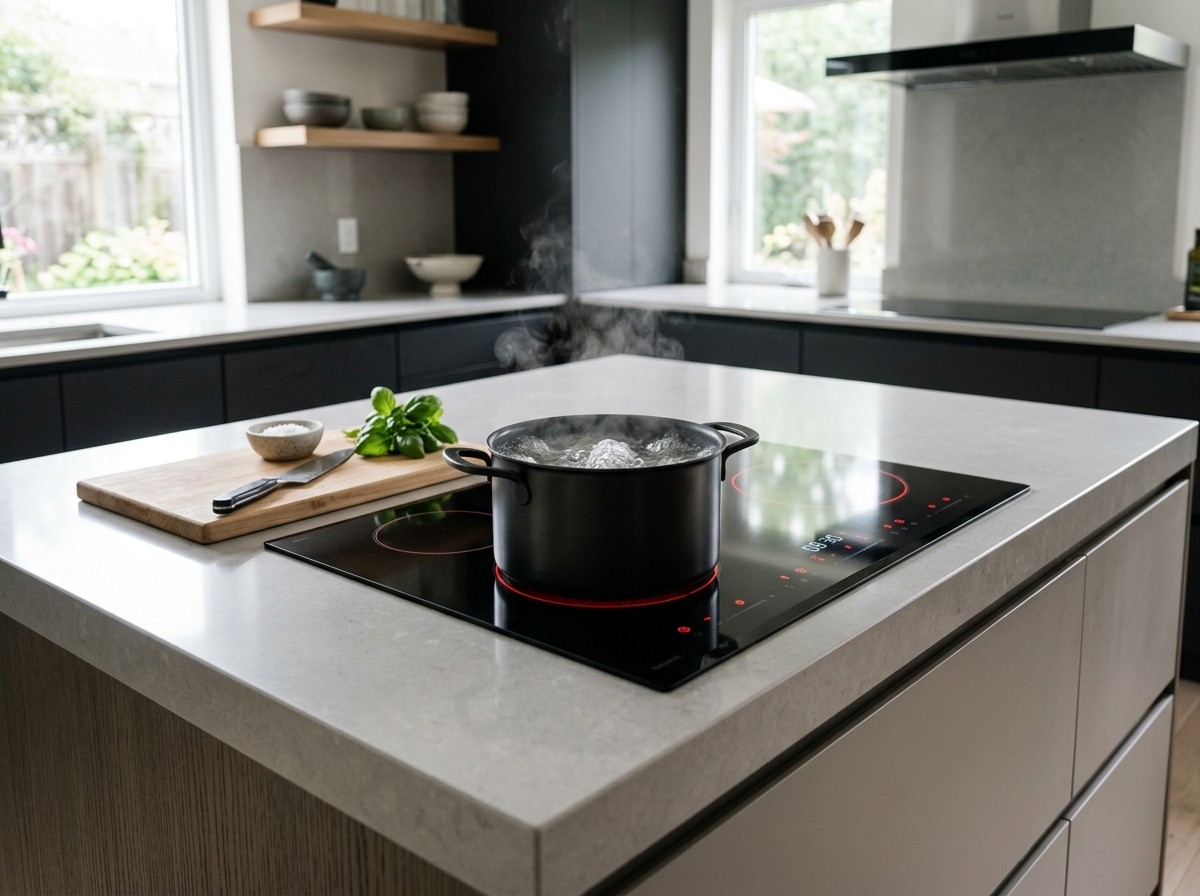
Choose an Induction Cooktop if you want unmatched boiling speed (6 quarts in under 5 minutes), effortless glass surface cleanup, and zero indoor combustion byproducts (NO2 / CO). Choose a Gas Cooktop if your home lacks dedicated 240V / 40A wiring or you frequently cook with round-bottom woks and non-magnetic copper/aluminum pans. We would decide from cookware, ventilation, heat control, utility constraints, and daily cleanup—not speed alone. The better cooktop is the one that fits the kitchen you already use.
Side-by-side comparison
| Decision factor | Induction cooktop | Gas cooktop |
|---|---|---|
| Energy efficiency | 85% to 90% heat transferred directly to pan | 32% to 40% (remainder heats kitchen air) |
| Water boiling speed | 2.5 to 4 minutes (6 quarts) | 6 to 9 minutes |
| Indoor air quality | Zero combustion emissions | Emits NO2, CO, and benzene during flame use |
| Surface cleanup | Flat ceramic glass (wipes clean instantly) | Removable heavy cast iron grates & burner caps |
| Cookware requirement | Magnetic cookware (Cast iron, magnetic stainless) | Any cookware material (Copper, aluminum, ceramic) |
| Electrical / Utility | Dedicated 240V 40A–50A circuit required | 120V ignition outlet + Natural Gas / Propane line |
1. How electromagnetic induction transfers heat
Unlike gas burners that ignite fuel to heat the air beneath a pot, induction uses copper coils beneath ceramic glass. When activated, an alternating current generates an oscillating magnetic field. This field induces eddy currents inside magnetic cookware, turning the pot itself into the heat generator.
Because the glass surface is only warmed indirectly by the hot pan, spilled tomato sauce or boiling soup will never bake onto the cooktop surface, making cleaning a 10-second task with a damp cloth.
2. Speed and temperature precision
In independent laboratory testing by the U.S. Department of Energy (DOE), induction cooktops deliver 85% to 90% of their generated energy directly into the food. Gas burners, by comparison, lose roughly 60% of their heat into the ambient kitchen environment.
This translates to boiling 6 quarts of water in less than half the time of an 18,000 BTU commercial gas burner, while also maintaining ultra-low simmers (100°F) for melting chocolate without a double boiler.
3. Indoor air quality and kitchen safety
Recent health studies highlighted by the Consumer Product Safety Commission (CPSC) demonstrate that unvented gas ranges generate elevated indoor concentrations of nitrogen dioxide (NO2) and particulate matter. Induction cooking produces zero combustion emissions, making it ideal for airtight modern homes and apartments.
4. Installation & electrical considerations
The main barrier to adopting induction is electrical infrastructure. Converting from gas to induction typically requires installing a dedicated 240-volt, 40 to 50-amp electrical circuit. If your electrical panel is full, a service upgrade may add to the upfront cost, though federal Inflation Reduction Act (IRA) rebates (up to $840) help offset these expenses in the US.
Which should you choose?
- Buy Induction if: You value fast weeknight meal prep, easy one-wipe cleaning, cooler summer cooking, and cleaner indoor air.
- Keep / Buy Gas if: You cannot upgrade your electrical panel, use non-magnetic copper pans, or prefer charring peppers and tossing food over open flames.
Sources and efficiency benchmarks
- ENERGY STAR: Residential Induction Cooktop Efficiency Criteria — heat transfer and thermal efficiency ratings.
- U.S. Department of Energy (DOE): Kitchen Appliance Energy Use — comparative energy loss data.
- Consumer Product Safety Commission (CPSC): Indoor Cooking Emissions — ventilation safety guidelines.