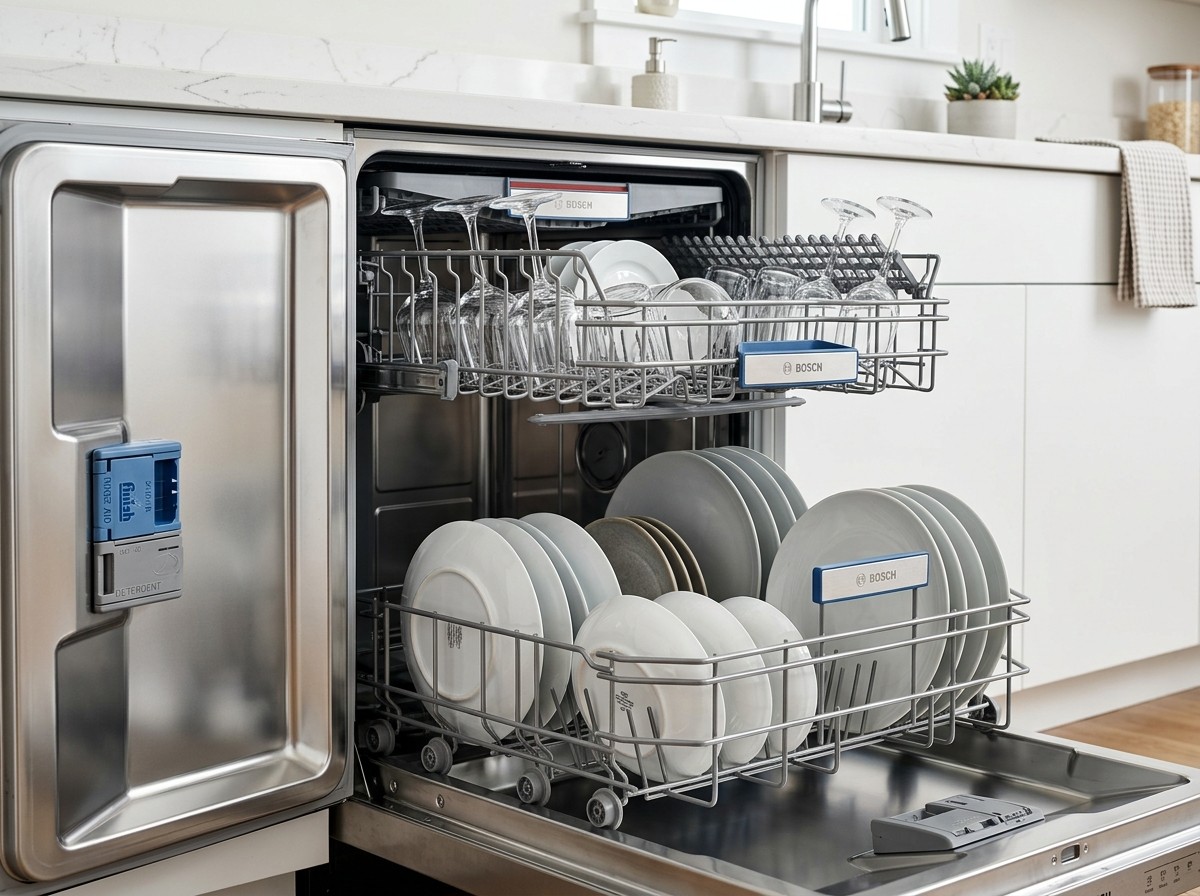
Start with rinse aid, the selected drying option, loading and incoming water. Some dishwashers use condensation or door-opening drying, while others use a heating element; the manual controls the expectation. Plastics often stay damp. If a heated cycle ends with the tub and ceramic dishes cold, or an error code appears, stop troubleshooting and arrange model-specific service.
1. Check rinse aid and the drying option
Drying systems differ by model. Condensation, fan, door-opening and heated options can all behave differently, so start with the owner's manual. Rinse aid helps water sheet off dishes instead of forming beads and is one of the fastest low-risk checks when glassware is wet.
Refill the dispenser and adjust it only a little at a time if the manual allows. A medium setting is not universal; water hardness and the exact dispenser determine the right dose. Do not assume a full dispenser proves that rinse aid is being dispensed.
2. Check incoming water and the cycle
Whirlpool recommends about 120°F (49°C) at the tap for good wash and dry performance. If the appliance is connected to the hot-water line and the heater is far away, the first fill can be cooler than expected.
Run the kitchen hot tap briefly before starting if your manual and plumbing setup support that routine. Also check that you did not select Air Dry, Eco or a short cycle when you expected a heated or extended dry result.
3. Load for drainage and use model-approved ventilation
Angle bowls, mugs and concave surfaces so water can drain, and avoid nesting items. If your model has Door Open Dry, AutoAir or a similar feature, use it according to the manual; do not force the door open on a unit that is not designed for that routine.
4. Expect plastics to dry differently
Plastic and silicone usually retain less heat than glass or ceramic, so they can remain damp even when the dishwasher is working normally. Place them on the recommended rack, angle them to drain and leave space around them. A wet plastic container alone is not proof of a failed heating element.
When to stop and call for repair
If rinse aid, the selected cycle, loading and water temperature are in order, but ceramic dishes and the tub are cold immediately after a heated cycle, a hardware or control issue is possible. Stop troubleshooting if you observe:
- Dishes and tub remain cold immediately after a cycle that should heat (do not diagnose a specific part from temperature alone).
- An error code, repeated breaker trip, leak, burning smell or visible wiring/element damage.
- Any condition that makes it unsafe to keep testing the appliance.
Bottom line
Before replacing parts, document the model number and test one manual-approved cycle after checking rinse aid, loading, water temperature and the drying option. These checks can separate a routine/setup issue from a service issue, but they cannot guarantee a dry result on every model or load.
Related checks: clean the dishwasher filter and spray arms, then review appliance measurements if the issue started after installation.
Sources and official maintenance guides
- Whirlpool Product Help: Dishes Not Drying — rinse aid, about-120°F water, loading and service checks.
- Whirlpool: Why Is My Dishwasher Not Drying Dishes? — drying-cycle and heating-element guidance.
- ENERGY STAR: Residential Dishwashers — efficiency context and model differences.
- Bosch Home Appliances: Dishwasher Not Drying — model-specific drying and service guidance.